
THE FUTURE OF MEMBRANE ARCHITECTURE
Why ETFE?
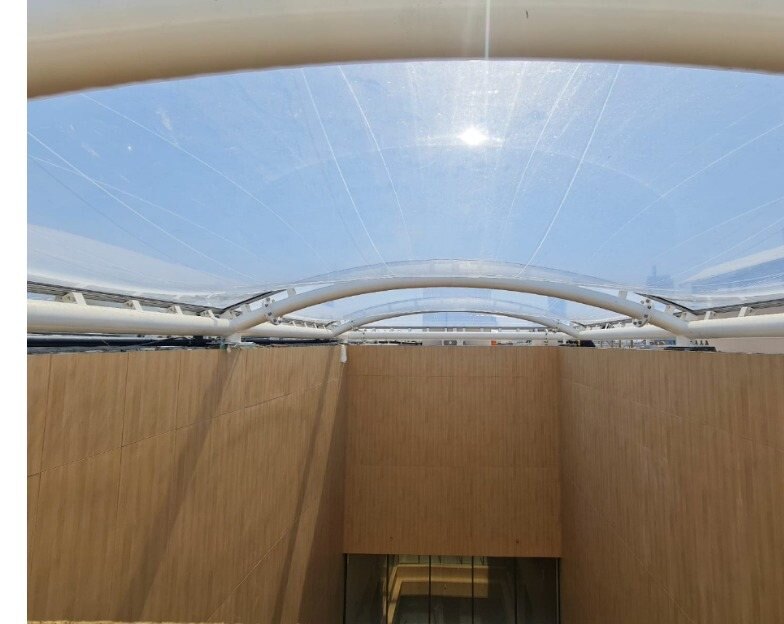
ETFE is the polymer that has redefined how large, daylight-filled spaces are built. Weighing roughly 1% of an equivalent area of glass and transmitting up to 95% of natural light, it makes forms and spans possible that no other transparent envelope material can deliver economically.
Because the envelope is so light, the structure carrying it becomes lighter too. Steel tonnage, connection sizes and foundation loads all reduce — and that saving frequently offsets a large part of the difference in envelope cost against a glazed alternative. Long spans can be achieved with slender members, keeping the roof visually open.
For the Saudi climate the material is equally well suited: it is unaffected by UV, heat and atmospheric pollution, and solar gain is controlled by design rather than by shading — through silver fritting on the outer foil, tinted or matt-diffused foils, and additional cushion layers.
STRUCTURAL BENEFIT
A single-layer ETFE panel weighs under 1 kg/m2 against roughly 30 kg/m2 for double glazing. The reduction carries through the whole load path: purlins, primary steel, columns and foundations. On long-span roofs this is normally the single largest commercial argument for the system.
SAFETY & ROBUSTNESS
ETFE does not shatter and cannot fall as sharp debris. It has exceptional tear resistance — cuts and punctures round out rather than propagating — and can be patched in situ. Its ability to absorb very high short-duration loading makes it a preferred envelope where blast or explosion risk must be considered.
Where ETFE Performs Best
- Stadium and sports venue roofs
- Atriums, malls and skylights
- Greenhouses and swimming pool halls
- Entrance canopies and walkways
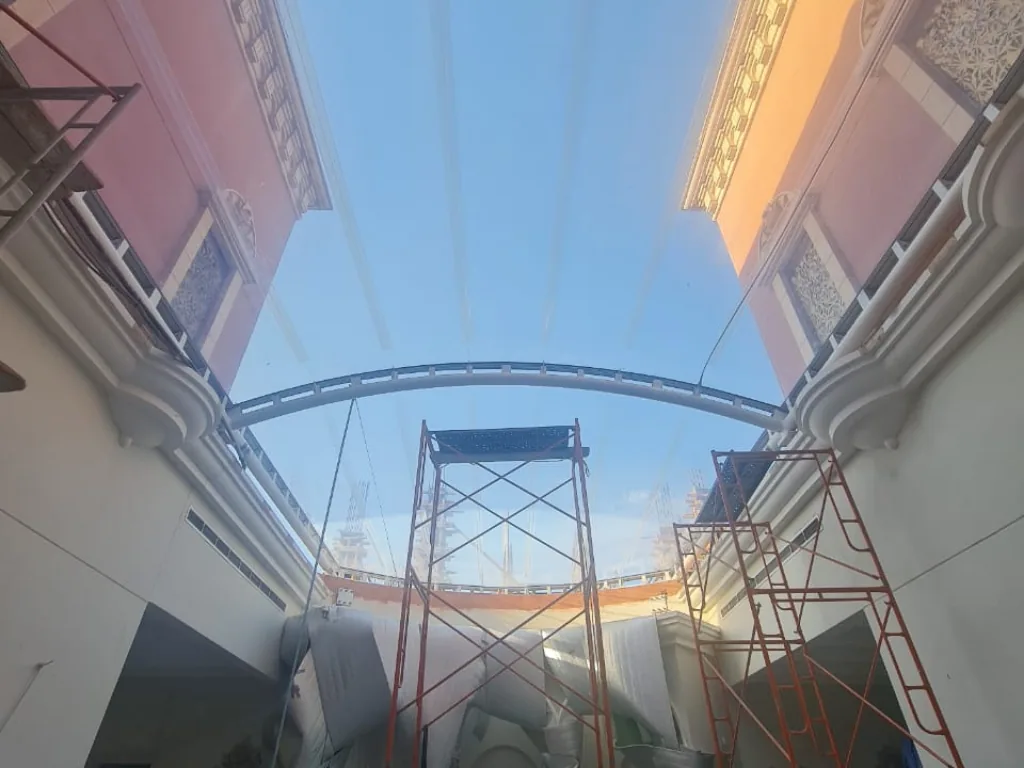
- Courtyards and light wells
- Translucent façades and light boxes
ETFE Performance Advantages
The properties that make ETFE the preferred envelope material for long-span, daylight-driven architecture in the Saudi climate.
LIGHTWEIGHT & TRANSPARENCY
ETFE film weighs less than 1% of equivalent glass, reducing structural loads. High light transmittance (up to 95%) maximizes natural daylighting.
DURABILITY & FLEXIBILITY
Exceptional resistance to UV, chemicals, and weathering with a lifespan exceeding 30 years. Cushions accommodate structural movement and complex geometries.
LOW MAINTENANCE & VERSATILITY
Self-cleaning surface reduces maintenance requirements significantly. Highly adaptable to custom shapes, printed patterns, and design expressions.
THERMAL CONTROL & EFFICIENCY
Multi-layer cushion systems provide excellent thermal insulation. Reduced dead load improves structural efficiency, lowering overall project cost.
- Ultra-lightweight at ~1% the weight of glass
- Up to 95% light transmission
- 30+ year lifespan, estimated in excess of 50 years
- 100% recyclable, including factory offcuts
- Self-extinguishing, no flaming droplets or molten debris
- Thermally efficient down to 1.4 W/m2K in a 4-layer build-up
Frequently asked questions
Why does a lighter ETFE roof reduce project cost?
Because ETFE weighs about 1% of glass, the whole structure carrying it can be lighter. The saving runs through the load path, from purlins and primary steel to columns and foundations. On long-span roofs this is normally the largest commercial argument for ETFE, and it frequently offsets much of the envelope cost difference against glazing. Learn more
Is ETFE suitable for the hot Saudi climate?
Yes, ETFE is unaffected by UV, heat and atmospheric pollution, which suits it well to the Saudi climate. Solar gain is controlled by design rather than by shading, through silver fritting on the outer foil, tinted or matt-diffused foils and extra cushion layers. Our double-layer cushion roof at MACHS in Dammam is one example. Learn more
Can ETFE break or shatter like glass?
No, ETFE does not shatter and cannot fall as sharp debris. It has exceptional tear resistance: cuts and punctures round out rather than spreading, and they can be patched in situ. Its ability to absorb very high short-duration loading also makes it a preferred envelope where blast or explosion risk must be considered. Learn more
Where is ETFE used best?
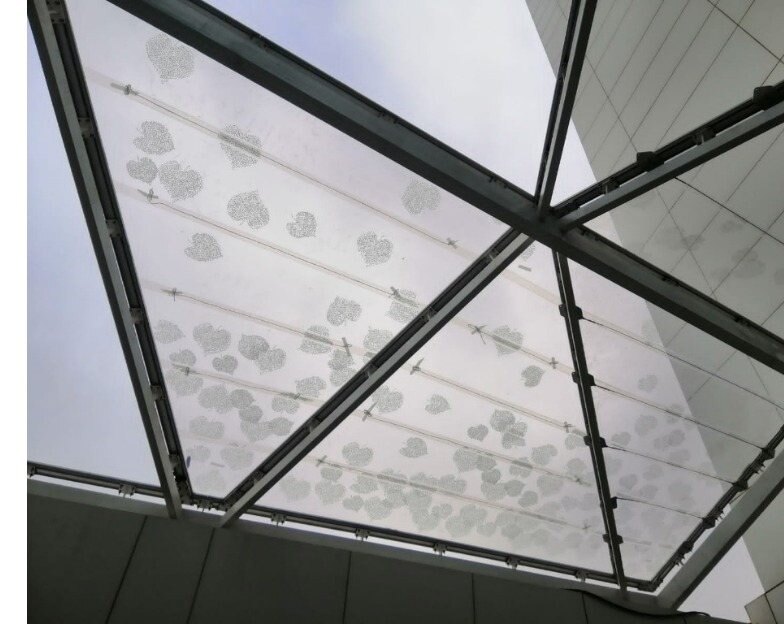
ETFE performs best on long-span, daylight-driven spaces such as stadium and sports venue roofs, atriums, malls and skylights. It also suits greenhouses and swimming pool halls, entrance canopies and walkways, courtyards and light wells, and translucent façades and light boxes, and can be printed with custom patterns, as on our single-layer canopy at Al Jubail. Learn more
Is ETFE a sustainable material?
Yes, ETFE is 100% recyclable, including factory offcuts, and has a service life of 30+ years, estimated in excess of 50. Its light weight reduces the steel and foundations needed, its self-cleaning surface reduces maintenance, and a four-layer cushion insulates down to 1.4 W/m²K. Up to 95% light transmission also maximises natural daylighting. Learn more
ETFE projects delivered
Planning an ETFE roof? Request a quote
Send us the area, the city and the fabric you need — we come back with a system and an indicative budget.