
THE MATERIAL
What Is an ETFE Roof?
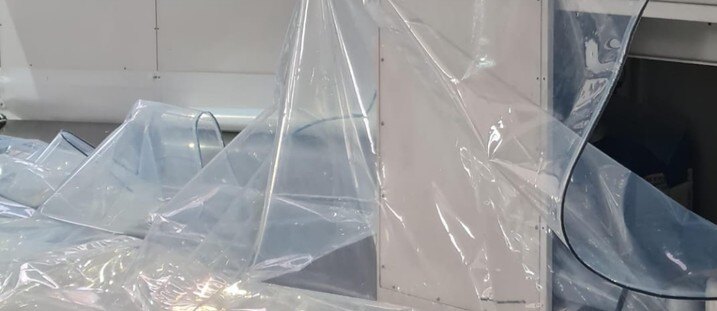
ETFE — ethylene tetrafluoroethylene — is a highly transparent fluoropolymer extruded into thin foils, typically 100 to 300 microns thick. In construction it is used in two ways: as a single-layer membrane tensioned between an aluminium perimeter extrusion and a supporting cable net, or as a multi-layer pneumatic cushion clamped into an aluminium extrusion and kept permanently inflated at low pressure.
SINGLE-LAYER SYSTEM
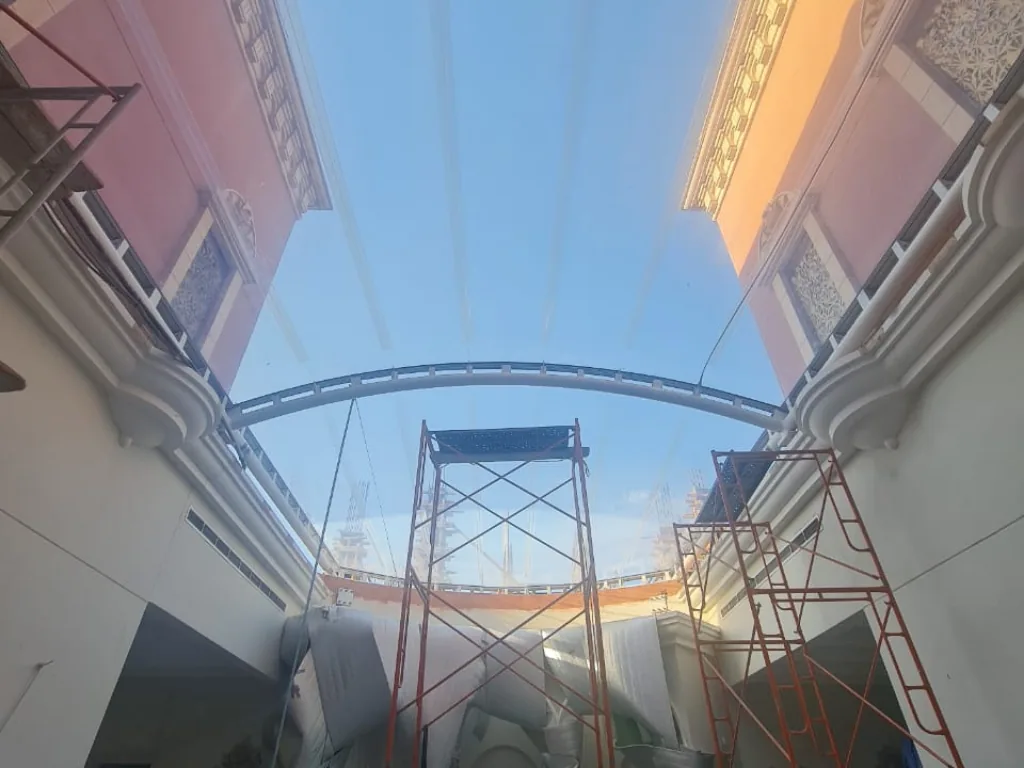
A single welded ETFE skin, mechanically clamped and pre-stressed, usually restrained by stainless steel cables. Requires no mechanical plant or power. Panel spans of up to approximately 20 m are achievable with adequate curvature and pitch. Ideal for canopies, courtyards, skylights and entrance features.
MULTI-LAYER CUSHION SYSTEM
Two, three or four ETFE foils welded around their perimeter and inflated to 250–300 Pa by a small air handling unit. The trapped air provides structural stiffness and thermal insulation. As a design guideline a rectangular cushion spans up to 3.5 m in one direction and any required length in the other.
Material Data
| Material | ETFE copolymer foil |
|---|---|
| Foil thickness | 100 – 300 µm |
| System self-weight | < 1 kg/m2 (approx. 1% of glass) |
| Visible light transmission | up to 95% (380 – 780 nm) |
| UVa transmission | 83 – 88% (320 – 380 nm) |
| Cushion pressure | 250 – 300 Pa |
| Inflation unit power | approx. 60 – 120 W |
| Service life | 30 years +, estimated 50 years |
| Recyclability | 100% recyclable |
Insulation (U-Value)
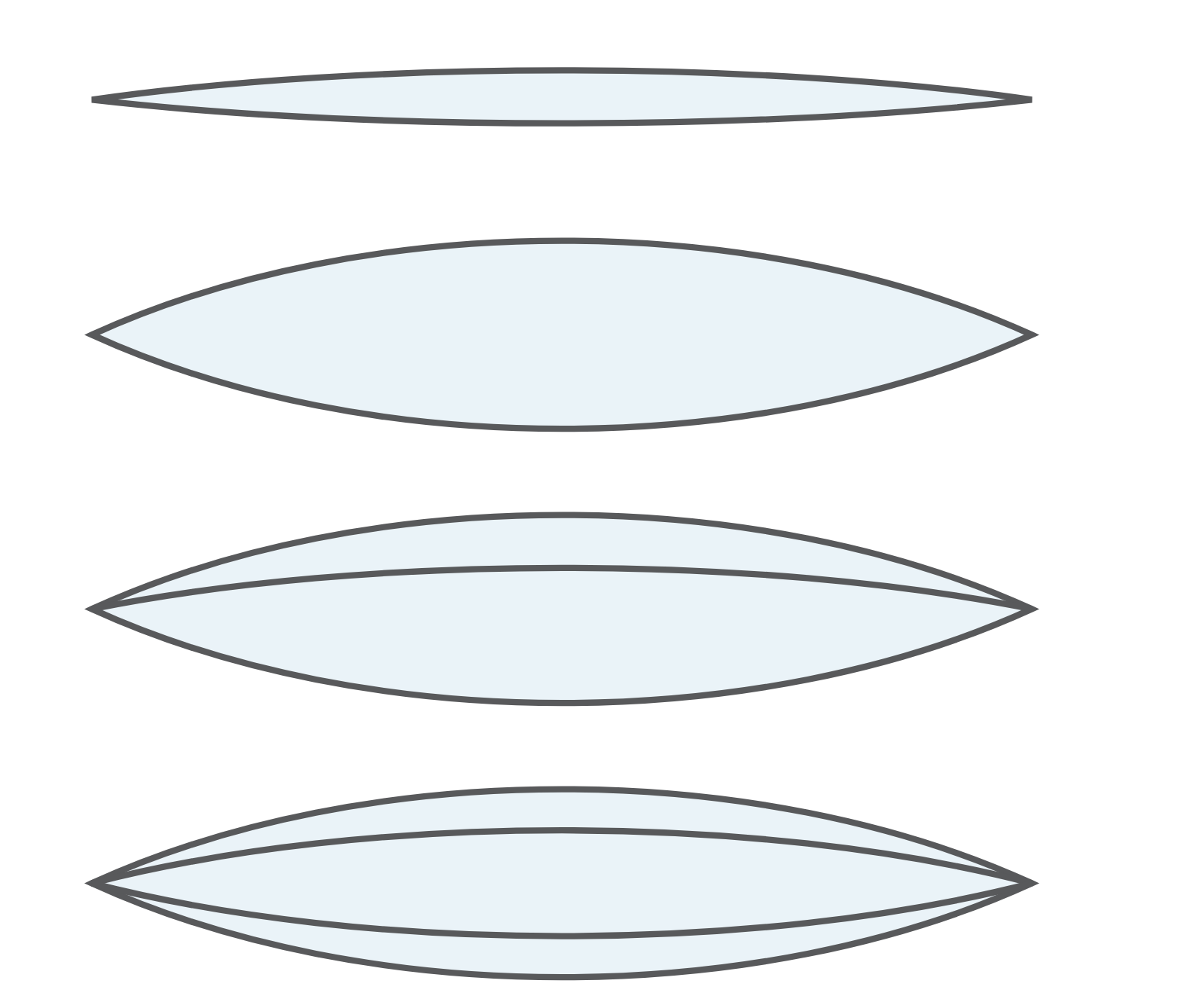
| Single layer | 5.6 W/m2K |
|---|---|
| 2-layer cushion | 2.9 W/m2K |
| 3-layer cushion | 1.8 W/m2K |
| 4-layer cushion | 1.4 W/m2K |
Values are generic properties of ETFE foil as a material. Project-specific figures are confirmed at design stage against the selected foil, layer build-up and print coverage.
Inflation & Control
A multi-layer ETFE cushion is a pneumatic structure. Its stiffness, its resistance to wind uplift and its insulating cavity all depend on air being maintained inside it.
AIR HANDLING UNIT
Each unit carries two fans running alternately, so only one operates at a time. Because the cushions only maintain pressure rather than generate continuous airflow, energy consumption is very low — in the order of 60 to 120 W.
MONITORING & FAULTS
Cushion pressure and system health are monitored continuously and reported through a simple status system. The control system reacts before it reports: if pressure falls, airflow to the cushions is increased automatically while the fault is logged.
LOSS OF POWER
Non-return valves hold the cushions inflated for approximately 3 to 6 hours after a power failure, depending on weather.
STANDARD PROVISION
PLC controller with touch screen, data logging and diagnostics · dual fans for load sharing and redundancy · air filtration and dehumidification · non-return valves · inverter-driven fans · local status indication and BMS interface.
Sizing the Air Supply System
A simple four-step method TMSI uses to confirm the right air supply unit for a project’s cushion volume.
- 01Total cushion volumeTake the total volume of the ETFE cushions. If unknown, estimate it as total surface area (length × width) divided by two.
- 02Air renewal rateTo keep the cushions free of humidity, the air inside is fully renewed twice per day: flow rate = (2 × volume) / 24 hrs. For 250 m3, that is approximately 20.83 m3/h.
- 03Add natural leakageAdd 5–10% for leakage through the piping and cushions. For 250 m3 at 10%, that is 25.00 m3/h — giving a total required flow rate of approximately 45.83 m3/h.
- 04Match to the unit rangeCompare the required flow rate and total volume against the unit specification to select the smallest unit that satisfies both figures.
Fire Performance
ETFE foil has low flammability and is self-extinguishing. Under fire, hot smoke causes the foil to soften and shrink away from the heat source, venting the space naturally; it produces no flaming droplets or molten debris. Typical material classifications are listed below. Certification is issued for the specific foil supplied on each project.
- DIN 4102 Class B1
- EN 13501-1 Class B-s1,d0
- BS 476 Parts 6 & 7 Class 0
- UL 94 V-0
- NFPA 701 Pass

Frequently asked questions
What is the difference between single-layer ETFE and ETFE cushions?
Single-layer ETFE is one tensioned skin that needs no power, while a cushion is two to four foils inflated by a small air unit. Single-layer panels, restrained by stainless steel cables, can span up to about 20 m with adequate curvature. Cushions are held at 250–300 Pa, and a rectangular cushion spans up to 3.5 m in one direction. Learn more
How thick is ETFE foil, and how much does it weigh?
ETFE foil is typically 100 to 300 microns thick, and the system weighs less than 1 kg/m², about 1% of glass. Despite being so thin it transmits up to 95% of visible light and 83–88% of UVa. Foil thickness, layer count and cushion size for each roof are outputs of that project's engineering analysis. Learn more
How well does an ETFE cushion insulate?
Insulation improves with each layer: the U-value is 5.6 W/m²K for a single layer, 2.9 for a two-layer cushion, 1.8 for three layers and 1.4 for four layers. The trapped air provides both stiffness and insulation. These are generic material values; project figures are confirmed at design stage against the chosen foil, build-up and print coverage. Learn more
What happens to an ETFE cushion roof if the power fails?
Non-return valves keep the cushions inflated for approximately 3 to 6 hours after a power failure, depending on weather. Beyond that, falling pressure leaves the roof exposed to wind damage, so standby power should be included in the building's electrical design. While powered, the controls raise airflow automatically if pressure falls and log the fault. Learn more
How is the air supply unit sized for an ETFE roof?
The unit is sized from the total cushion volume in four steps. Estimate the volume as roof area divided by two if unknown, renew the air twice a day, add 5–10% for leakage, then pick the smallest unit meeting both flow and volume. For example, 250 m³ of cushions needs about 45.83 m³/h of dry air. Learn more
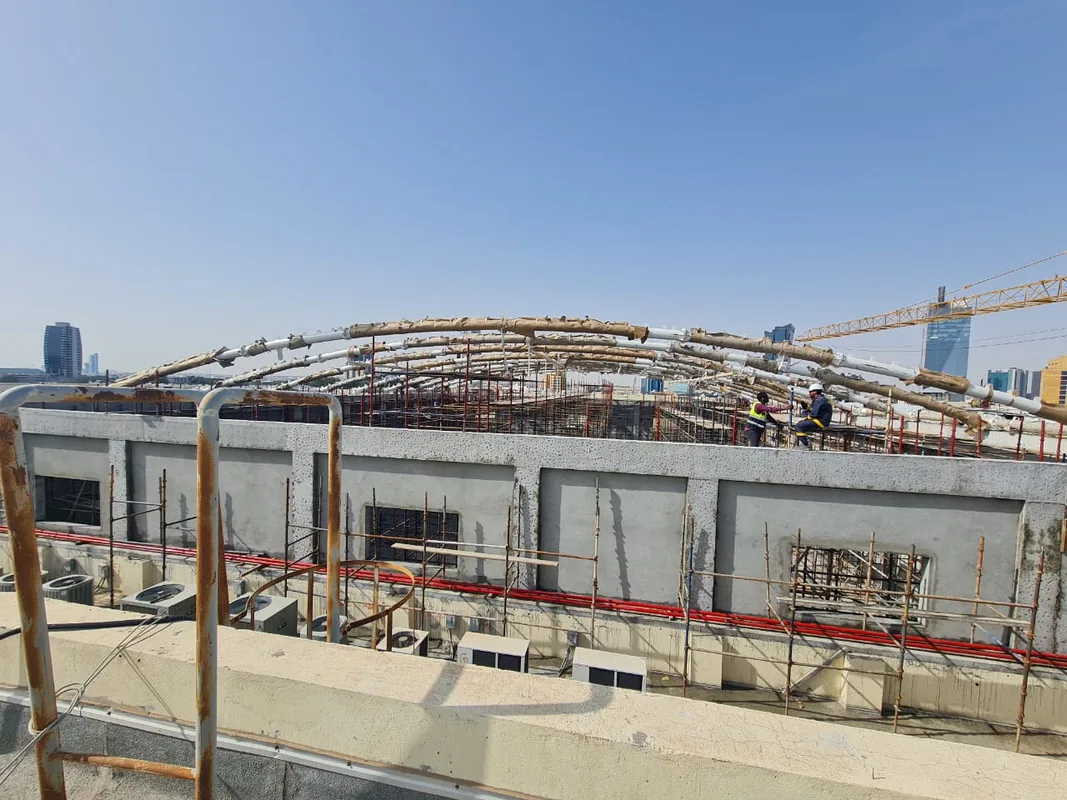
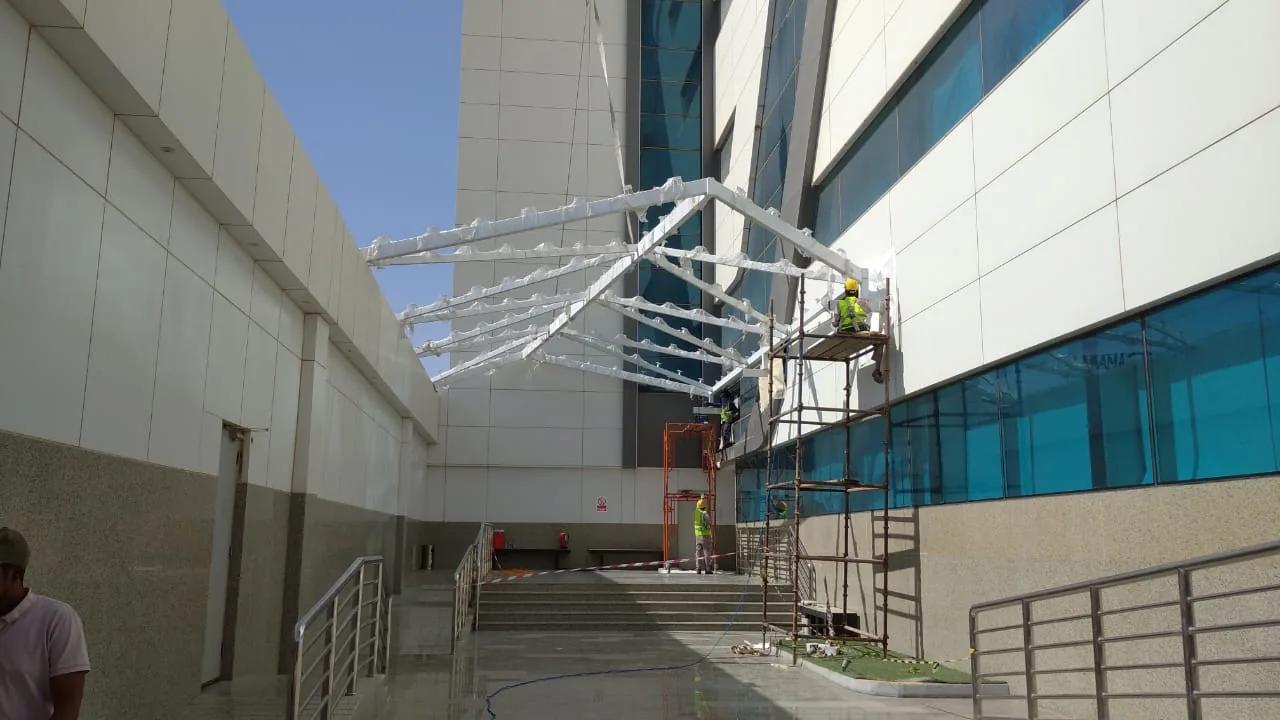
ETFE projects delivered
Planning an ETFE roof? Request a quote
Send us the area, the city and the fabric you need — we come back with a system and an indicative budget.