
PRODUCT RANGE
Air Supply Units — Blue Line, Green Line ECO & Mobile
High-quality components and in-house module design give TMSI’s air supply units their technological edge, translating into a considerable economical and ecological advantage for both the installing team and the building’s operator. Each unit combines pressure generation and dehumidification into one factory-built module of redundant fans, a condenser or adsorption dehumidifier, and programmable controls and sensors — able to run as a single-unit system for smaller projects or be assembled into multi-unit combinations for larger roofs, all programmed from one terminal via a master unit.
How the units are built
DURABLE, PURPOSE-BUILT HOUSING
Units are housed in stainless steel or powder-coated aluminium cases, giving reliable, weather-resistant protection to the integrated fans, dehumidifier and controls — built to need no replacement over the life of the roof, only periodic cleaning.
FREQUENCY-MODULATED REDUNDANT FANS
Twin frequency-modulated fans deliver exactly the air pressure called for by the control program, continuously verified by pressure sensors. Because throughput is modulated rather than switched on/off, required pipe diameters — and airflow noise — are both reduced.
HARD-WIRED SENSORS & PROGRAMMABLE CONTROL
All sensors are hard-wired directly to the unit, eliminating the measurement drift that tube-based sensor connections can introduce, and every unit is programmable and computer-controlled for straightforward on-site editing of system parameters.
MODULAR, NETWORKABLE & ENERGY-AWARE
Single units suit smaller projects; multiple units combine under a master controller for larger roofs, with every editing and monitoring function available from one terminal. Our ECO series adds closed-circuit air reuse, and humidistats run the dehumidifier only when ecologically worthwhile.
Blue Line — the standard range
Our standard-line units are available in six setups — Basic, 150, 400, 600, 900 and 1400 — sized to match individual project demand. A single unit provides clean, dry air for roof and facade applications of up to approximately 3,700 m³, with multiple units combined to match larger requests.
Each unit integrates three core components: dehumidification of the supply air using an adsorption dehumidifier; compression of air using two redundant, alternating fans; and a switchboard with a programmable control unit and, on all but the 150 and Basic sizes, standard min./max. and analogue pressure sensors, plus interface sockets for optional devices.
The redundant fans automatically alternate every 9 hours; if one fails, the second takes over immediately, an alarm lamp illuminates and an alarm signal is sent by the control unit. For initial inflation, or in case of high leakage from a damaged pillow or other special circumstances, both fans can run in parallel.
The adsorption dehumidifier releases moisture in a warm air stream vented from the side of the case — no condensate fluid escapes the unit. The programmable control (basic display on all but the Basic model) handles initial setup and maintenance editing, and five free contacts carry alert messages to the building management system. With additional valves and fan units, the same unit can also be upgraded to move a flexible middle layer inside a three-layer pillow to provide shading.
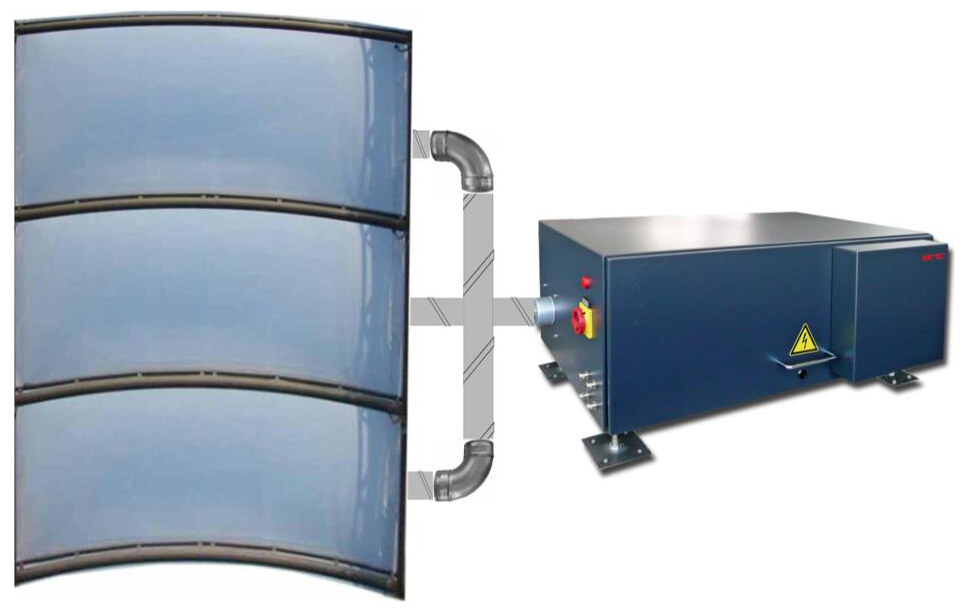
Green Line ECO — the high-efficiency range
Our ECO series (available in S, M and L sizes) is a further development of the standard line, built to respond to the growing demand for reduced-energy devices and building certifications such as LEED or BREEAM. A single ECO unit serves applications up to approximately 1,800 m³, as a single unit or in multiple-unit configurations.
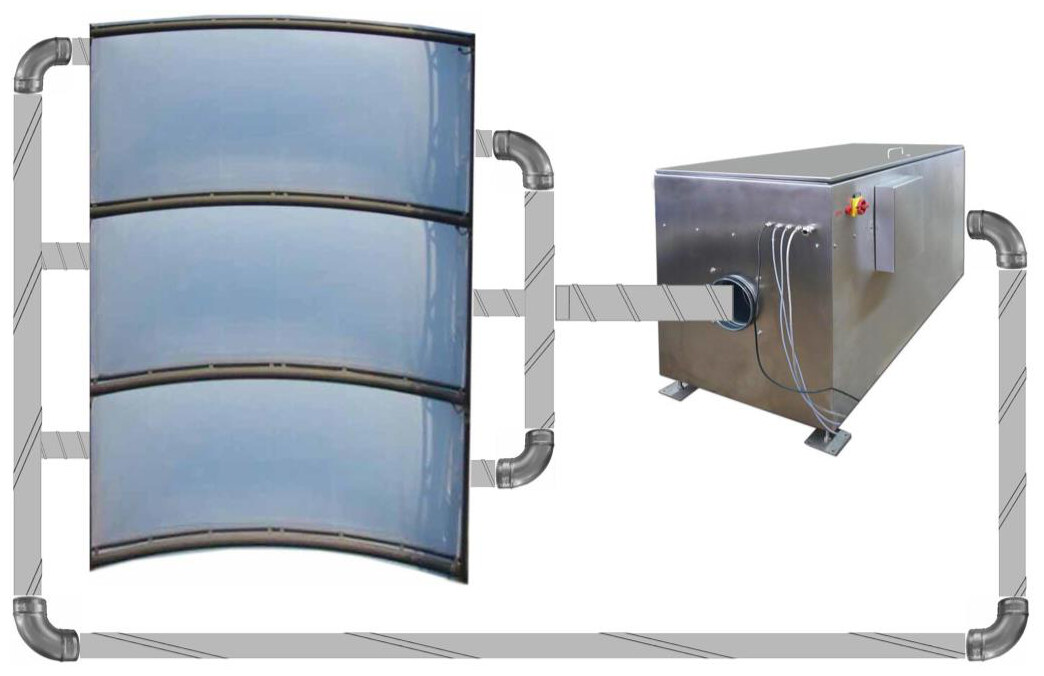
Adding a return path for the dried air creates a closed circuit maintained by the ECO unit: once the pillows are fully inflated, only the small volume of external air needed to cover natural leakage from the pillows and piping is ever added. Dried air is permanently circulated by an additional fan unit across the whole circuit to avoid any possibility of condensation, while a humidistat permanently monitors humidity inside the closed loop and switches the dehumidifier on only when necessary.
Because the dehumidifier consumes the most power in an air supply system, this reduced drying demand can lower overall power consumption by up to 70% in some cases.
Like the standard unit, the ECO series includes redundant fans, a dehumidifier and a switchboard — with three key differences: a large additional overpressure case integrated into the unit; dehumidification by a condenser dryer inside that overpressure case; and an additional circulation fan for the closed-loop air path. Condensed water is collected inside the overpressure case and released on demand through an outlet pipe. All other features and options match the standard line.
Specifications overview
Blue Line sizes and the mobile unit, as published in the specifications overview. ECO versions need less fresh air and are sized individually.
| Basic | 150 | 400 | 600 | 900 | 1400 | Mobile | |
|---|---|---|---|---|---|---|---|
| Dry air flow rate (m³/h) | 80 | 80 | 190 | 275 | 400 | 800 | 190 |
| Max. emergency flow (m³/h) | 120 | 300 | 800 | 1200 | 1800 | 2800 | 190 |
| Roof/facade volume (m³) | <50 | <300 | <800 | <1400 | <2000 | <3700 | <300 |
Mobile & temporary units
For construction-site use, mock-ups, and short-term research or development needs, TMSI can supply compact, portable air supply units alongside our permanent installations.
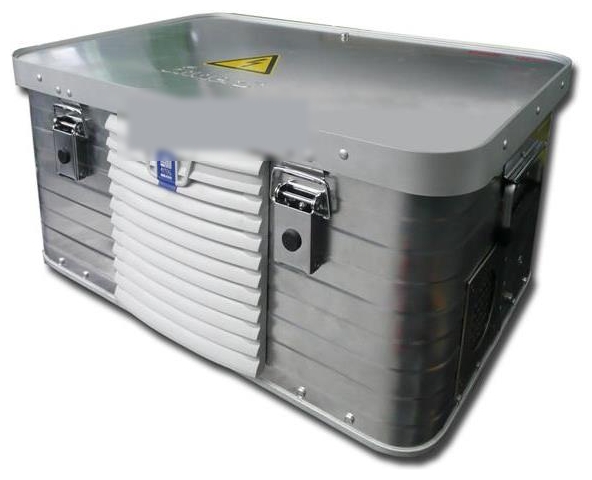
MOBILE AIR SUPPLY UNIT
Provides filtered, dried air for pillows of up to approximately 300 m³ at pressures up to 1,200 Pa. An integrated programmable control with display allows precise on-site set-up. As it has no second redundant fan, it is intended for temporary use rather than permanent supply.
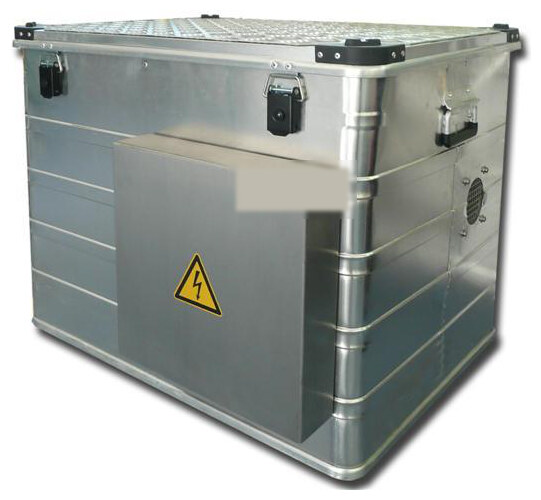
SUPPORTING BLOWER
A compact filtered-air source for mock-ups or temporary site supply, for cushions up to approximately 200 m³ at pressures up to 1,000 Pa. Output is adjustable by an internal control dial; air is filtered but not dried. Connects to 110V or 240V, 50/60Hz supply.
Frequently asked questions
Is dehumidification really necessary?
Yes. Humidity and temperature swings shift the dew point onto surfaces inside the pillow; without dried air, condensation leads to clouding and algae growth. Our systems target roughly two full air changes per day under high-humidity conditions.
What is the expected service life?
Cases are stainless steel and effectively never need replacing, needing only periodic cleaning. Fans have an MTBF of about 40,000 hours each (over 9 years alternating); dehumidifiers run 30,000–40,000 hours (about 4–4.5 years). A well-maintained unit should serve for 25 years.
Is there a documented maintenance schedule?
Yes — TMSI can issue a maintenance protocol listing every item to check. The air filter is the most time-critical item and should be replaced at least every six months, more often in polluted environments.
What is the standard product warranty?
A 24-month bring-in warranty on the air blower station (or on-site exchange by a local electrician) and 12 months on turning parts — fans and dehumidifier. In most cases we can diagnose the fault by phone and dispatch only the failed part, avoiding the need to return the whole unit.
Will there be condensation from the heating element, and is it drained?
No, if the unit is placed outdoors — warm humid air simply exits through the side exhaust. If placed indoors, that exhaust must be ducted outside; there is no internal condensate tray. On ECO units the condensate is pumped out as water and must be routed outside or drained if installed indoors.
How do I arrange the pipe layout and dimensions?
Pipe diameters depend on pipe length, the number of pillows, and the number of bends, since each element adds resistance to the airflow. To achieve the correct air-exchange rate for dry-air input, we run a resistance calculation using specialised software against the individual project data, and are glad to support this pipe-dimensioning exercise.
Why can TMSI’s main pipe dimensions be smaller than competing suppliers?
Because our units use frequency-controlled fans rather than simple digital on/off fans, we can track the exact air volume required rather than swinging between 0% and 100% throughput. Conventional on/off systems must size pipework for that full swing, often requiring 50% or more additional diameter compared with our systems.
When does the ECO series pay back its extra cost versus the standard line?
Alongside the price difference between an ECO and a standard unit, the cost of the return pipework needs to be included in the amortisation calculation. Based on recent project experience, payback is typically 3 to 6 years — a strong case for the ECO line on any roof with an expected service life beyond 20 years, and we’re glad to work through the calculation for a specific project.
What is the working principle of the wind sensor?
The standard pressure setting is 300 Pa. If wind speed exceeds 10 m/s for more than 6 seconds, pressure switches in one step to 600 Pa and is held. Once wind speed drops below 0.5 m/s, the elevated pressure is held for a further 6 minutes before returning to 300 Pa — and if wind exceeds 10 m/s again during that window, the pressure remains at 600 Pa rather than dropping.
Choosing an air supply unit? Talk to our engineers
Technical consultation to select the right air supply unit for your project.