
AIR SUPPLY & CONTROL
Air Supply Systems for ETFE Cushions
Inflated ETFE cushions have become the roof and facade solution of choice for stadiums, airports, transit stations and aquatic centres worldwide, prized for their light weight, transparency and architectural expression. Every one of these structures depends on a permanent, correctly engineered air supply to stay inflated, stable, and free of internal condensation.
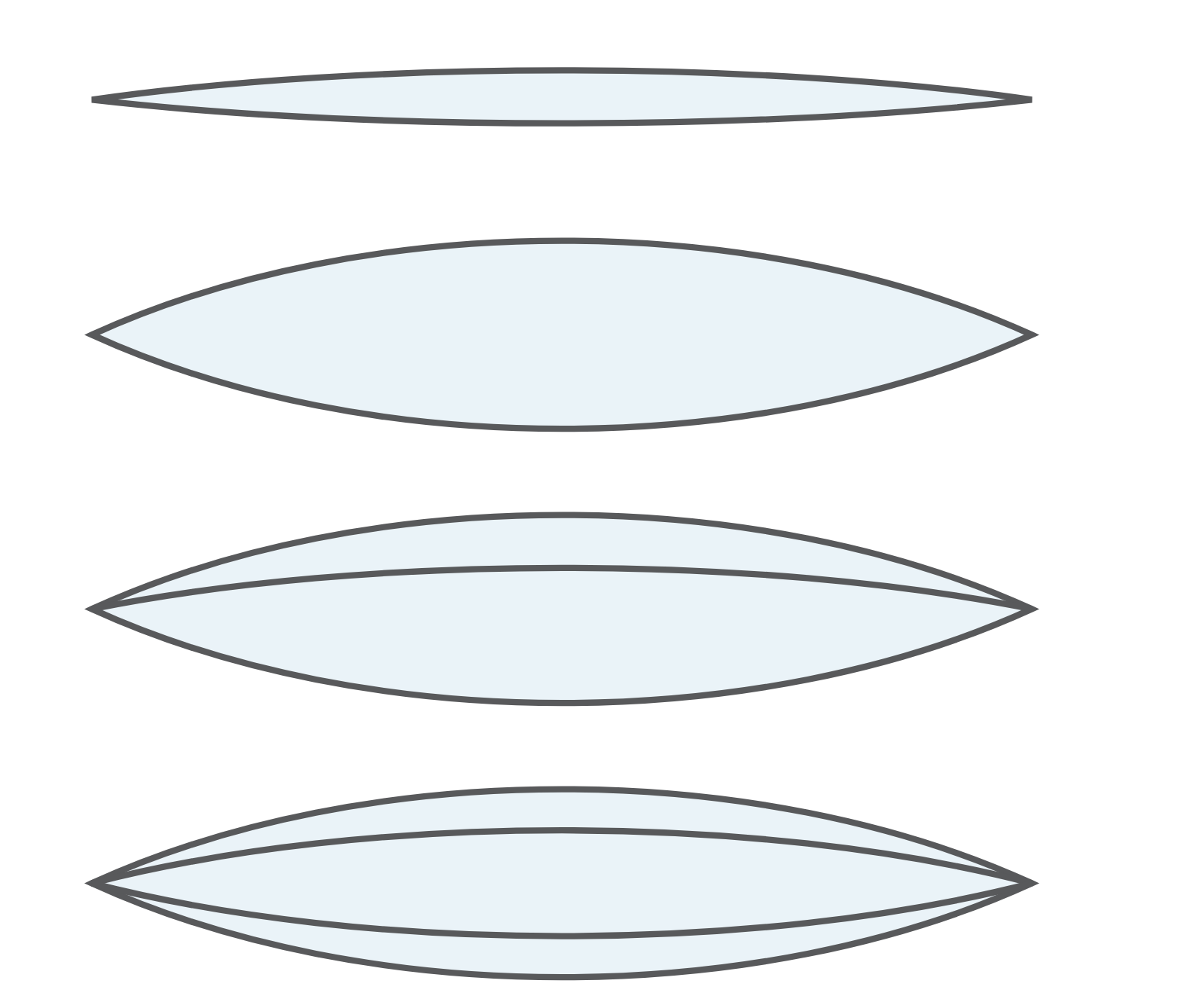
What the air supply does
CONSTANT SUPPORT PRESSURE
TMSI-specified inflation units hold a steady internal pressure — typically 200 to 350 Pa above ambient — so the cushion retains its designed form and structural stiffness around the clock.
ADAPTIVE TO WIND & SNOW LOADS
Pressure is not fixed. As external wind or snow loading increases, the air supply automatically raises the internal pressure difference to safely carry the additional load, then returns to normal once conditions ease.
INTEGRATED DEHUMIDIFICATION
Supplied air is continuously dried before entering the cushion, preventing condensation on the inner foil surfaces that would otherwise cause clouding and long-term algae growth.
A pneumatic structure, not a static one
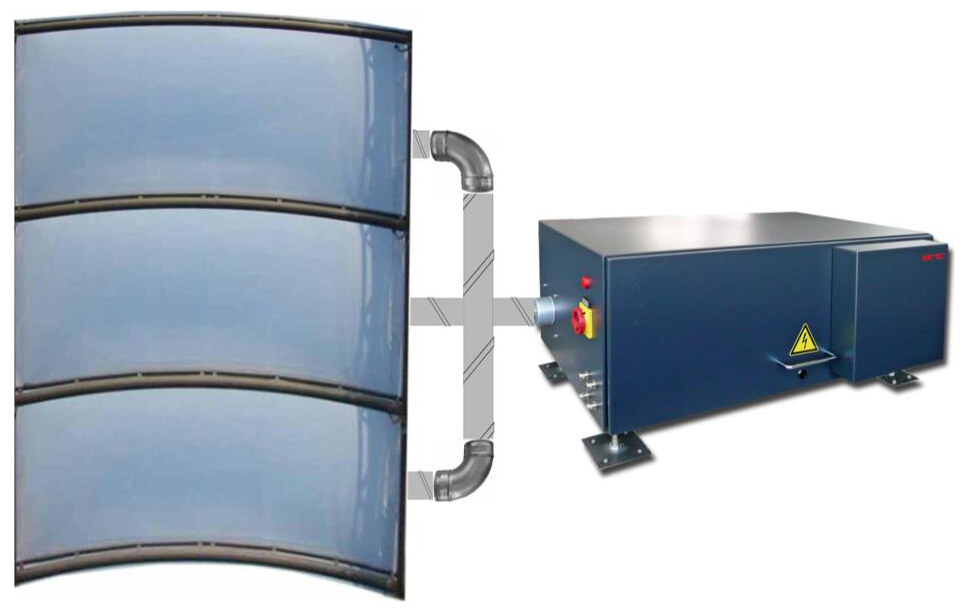
A multi-layer ETFE cushion is a pneumatic structure. Its stiffness, its resistance to wind uplift and its insulating cavity all depend on air being held at a low, constant pressure — typically 250 to 300 Pa. That air is supplied by a small air handling unit connected to every cushion on the roof by a distribution pipework network.
Because the cushions only maintain pressure rather than generate continuous airflow, energy consumption is very low — in the order of 60 to 120 W. A single unit typically serves an entire roof; on large installations multiple units are networked to share load and provide redundancy.
Each unit carries two fans running alternately, so only one operates at a time. If a cushion is damaged, pressure drops or severe weather is detected, both fans run together to hold a steady pressure. A typical unit occupies roughly 1.0 × 0.5 m and needs a dedicated, secure power supply.
Standard provision
PLC CONTROLLER
With touch screen, data logging and diagnostics.
DUAL FANS
For load sharing and redundancy.
AIR TREATMENT
Air filtration and dehumidification of the supply air.
NON-RETURN VALVES
To limit air loss on shutdown.
INVERTER-DRIVEN FANS
For efficiency.
LOCAL STATUS & BMS
Local status indication and BMS interface.
Sizing your air supply system
A simple four-step method TMSI uses to confirm the right air supply unit for a project’s cushion volume — for standard units; ECO versions need less fresh air, and we size those individually.
- 01TOTAL CUSHION VOLUMETake the total volume of the ETFE cushions. If unknown, estimate it as total surface area (length × width) divided by two — e.g. 500 m² of roof is approximately 250 m³.
- 02AIR RENEWAL RATETo keep the cushions free of humidity, the air inside is fully renewed twice per day: flow rate = (2 × volume) / 24 hrs. For 250 m³, that is approximately 20.83 m³/h.
- 03ADD NATURAL LEAKAGEAdd 5–10% for leakage through the piping and cushions. For 250 m³ at 10%, that is 25.00 m³/h — giving a total required flow rate of approximately 45.83 m³/h.
- 04MATCH TO OUR UNIT RANGECompare the required flow rate and total volume against the specification table to select the smallest unit that satisfies both figures.
Worked example
250 m³ of cushions needs 45.83 m³/h of dry air → the smallest unit satisfying both figures provides up to 80 m³/h and covers volumes under 300 m³.
Reference implementations
TMSI specifies and integrates this class of air supply and dehumidification system on our ETFE packages. The units themselves carry an established global track record spanning stadiums, airports, transit stations and cultural venues over more than 15 years, a selection of which is shown below.
A selection of reference projects
| Atlanta Airport, USA | 6 units with dehumidification, wind & snow sensor, master control unit |
|---|---|
| BC Place Stadium, Vancouver | 5 units with dehumidification, roof inflation/deflation, master control |
| Zenit Arena, St. Petersburg | 4 units with master control, LAN, snow height sensor, BACnet |
| Coliseo El Campín, Bogotá, Colombia | 4 units with dehumidification |
| NWC, Hong Kong | 4 units with dehumidification, esignaller |
| Mall of Africa, Johannesburg | 3 units with dehumidification |
| Chinese University, Hong Kong | 2 units with dehumidification, wind sensor, WAP |
| Botanical Garden II Magok, Seoul | 2 units with dehumidification, wind & snow height sensor, external display |
| Waterpark Tyumen, Novosibirsk, Russia | 2 units with dehumidification, Pmin + Pmax |
| Barangaroo, Sydney, Australia | Air supply unit with dehumidification |
| Atrium Mall, Bahrain | Air supply unit with dehumidification, wind sensor |
| African Union Peace & Security B., Addis Ababa | Air supply unit with re-circulating air |
| Papyrus, Brunn, Austria | Air supply unit with dehumidification, snow height sensor, wind sensor |
| Sparkasse, Imst, Austria | Air supply units with recirculating air |
| Global Intern. Indian School, Singapore | Air supply unit with dehumidification, wind sensor |
| Sattva, Hyderabad, India | Air supply unit with dehumidification |
| St. Francis Hospital, Tulsa, USA | Air supply unit with dehumidification (UL certified) |
| Aida Ships | Air supply unit with dehumidification (special sea version) |
Choosing an air supply unit? Talk to our engineers
Technical consultation to select the right air supply unit for your project.